John Ball's Early Life Revealed
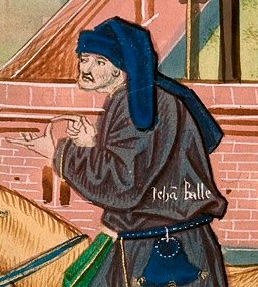
Research by the People of 1381 team has uncovered a great deal of new information about the life of John Ball, the radical preacher whose use in his sermons of the old motto 'When Adam Delved and Eve Span, Who Was Then a Gentleman' helped inspire the revolt. The new discoveries show that Ball held benefices in Suffolk and Norfolk, conflicting with previous assumptions connecting him with Essex and York. They also show that from at least 1364 Ball was active as a roving preacher and agitator across a wide area of Essex, Kent, East Anglia and the East Midlands. Above all, Ball managed to gather a band of lay followers as early as 1370
These new findings will be presented at the Essex Record Office on Saturday 13 June at 10.30am. Tickets cost £8-£12 and are available at:
Registers of medieval bishops and other ecclesiastical records reveal that John Ball probably came from the village of Thrandeston in Suffolk, near Diss. In 1349, Ball became vicar of Yoxford in Suffolk, then in 1350 was instituted as vicar of Griston in Suffolk. The income from these posts was small and by 1352 Ball had resigned as vicar of Griston.
In October 1356, Ball was presented by King Edward III to the wealthier vicarage in Gazeley in Norfolk, but for some reason he never became vicar of Gazeley. This may have been a pivotal event in Ball’s career. Sometime between about 1362 and 1364, Ball was excommunicated for the first time by Simon Islip, the Archbishop of Canterbury.
In 1364, Ball claimed that his enemies were threatening to assault him and was given letters of protection by the King, but the King heard that Ball was wandering from place-to-place preaching heretical ideas, and the King withdrew his protection. Among the many places where Ball was active as a preacher was Essex. In 1364 and 1366, orders were made to arrest Ball as a heretical preacher and the Dean of Bocking was instructed to make Ball appear before the Archbishop of Canterbury. It has been suggested that John Ball had a strong connection to Colchester and the surrounding villages, and that he originated from there, but this seems to be improbable.
Ball moved on again and by 1370 was based near Leicester. John Buckingham, the Bishop of Lincoln, sent a letter to all clergy in the Archdeaconry of Leicester and the Deanery of Guthlaxton, warning them against Ball, ‘a man with a malicious and raging mind, claiming to be a chaplain, said to have been wandering around for many years and leading a grievous and dissolute life, preaching without any authority whatsoever’. Until now, historians have treated Ball as a rogue individual, but it is clear from the letter that he had gathered followers who took him seriously. He also had the common touch, preaching ‘not only in churches and cemeteries but in markets and other profane places’.
Ball was perhaps the forefather of the later ‘hedgerow preachers’ whose incendiary rhetoric appealed to the masses. Intriguingly, the Deanery of Guthlaxton included Lutterworth, where the controversial theologian John Wycliffe was appointed rector in 1374 and to which Wycliffe retired after 1382, but any direct link between Ball and Wycliffe remains unproven.
The Bishop of Norwich excommunicated John Ball of Thrandeston again in 1372. By 1376, Ball was back in Essex, where the vicars of Panfield near Braintree and Little Tey as well as others were ordered to arrest him.
Ball was repeatedly denounced in the following years, first in 1376 and 1377 by Simon Sudbury, the Archbishop of Canterbury executed in the Peasants’ Revolt, and again by the Bishop of London in 1379. This game of ecclesiastical cat and mouse culminated in a final denunciation in April 1381 by Simon Sudbury. Ball was arrested as a result of this order. The rebels released him from prison and he joined the rising.
After the revolt, Ball fled back towards the Midlands, where he was arrested in Coventry. An exchequer record describes the payment of twenty pounds to John Wychard and John Marton, two prominent inhabitants of Coventry, for their expenses in bringing Ball from Coventry to St Albans where he was put to death.
Despite his summary execution, Ball has been subsequently revered as a social visionary, most famously by William Morris in his Dream of John Ball.
These new findings about Ball not only shed light on a celebrated figure in English history but also help us understand the life of clergy in the fourteenth century and why so many joined the revolt in 1381.
The People of 1381 team are grateful to Dr Alison McHardy in generously sharing information and to the staff of Norfolk Record Office and Lincolnshire Archives.